An introduction to Friedrich Froebel

Friedrich Froebel

Who was Friedrich Froebel?

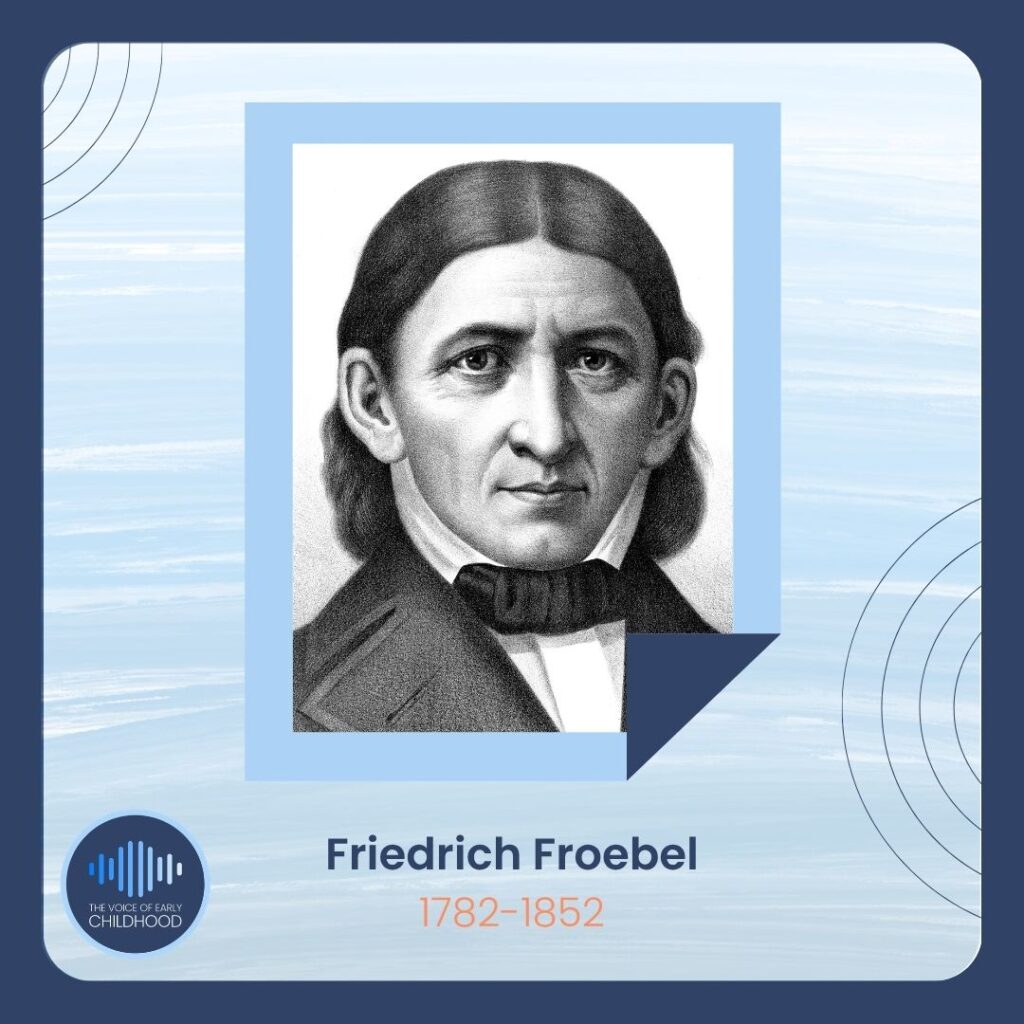
Friedrich Froebel was a German educator who lived from 1782 to 1852 and became one of the most significant early childhood pioneers (Tovey, 2017). He was the creator of the first ‘kindergarten’, translated from German as ‘children’s garden’, which highlighted the importance of children’s development and learning during the early stages of life (Bruce, 2012). Froebel’s own childhood was a big influence on his philosophy as he spent a lot of time in the garden when growing up, which is evident in his beliefs around the value of outdoor play (Bruce, 2012). Froebel’s key belief underpinning his philosophy was the importance of play, as he emphasised that play is the highest form of learning and development, where children are able to freely express themselves (Rose, 2022).  

Froebelian principles

The Froebelian approach is underpinned by 8 key principles, which are focused around creating an interactive educational environment that is child-centred (Rose, 2022).  

What are the Froebelian principles?  

Unity and connectedness 

Autonomous learners 

The value of childhood in its own right 

Relationships matter 

Creativity and the power of symbols 

The central importance of play 

Engaging with nature 

Knowledgeable, nurturing educators 

Froebel’s gifts and occupations

Froebel introduced gifts as resources for children to develop their learning and understanding of various concepts, subjects and laws of nature, such as maths, science, architecture and engineering, essentially forming an understanding of the world around them (Froebel Trust, 2023; Lawrence, 2012). The most commonly known ‘Froebel’s gifts’ are wooden blocks, which were the first blocks created specifically to support young children’s development (Froebel Trust, 2023).  

Like Froebel’s gifts, occupations are sometimes also known as various resources or materials. The Froebel Trust (2023) explains occupations as craft activities fostering independence and relating to real-life and practical work. Some sources explain the occupations to be more like specific areas to gain understanding of. For example, Weber (1969 in Jarvis, Swiniarski and Holland, 2016) explains occupations as ‘areas of study’, the four areas Froebel emphasised being solids, surfaces, lines and points. Weber explains that these areas are investigated through the use of open-ended and malleable materials, such as clay, paper, natural objects etc. and using activities such as drawing cutting, folding, woodwork, stringing beads etc. Rose (2022) and Jarvis, Swiniarski and Holland (2016) explains that occupations are primarily used to support both children’s creativity and their understanding of the world (through the creative process), as well as supporting their fine motor skills. For example, children can unpick and represent various aspects of their lives through creative processes, such as storytelling, role play, painting etc. Using Froebel’s gifts and occupations also facilitates children’s fine motor development, which is a key focus of Froebelian pedagogy.   

Both the gifts and occupations encourage children to form understanding of the world around them as they playfully engage with the open-ended materials, with the support of an adult, solidifying their learning through exploration and creativity as they liken the blocks to the world around them (Froebel Trust, 2023). Froebel often used the terms gifts and occupations interchangeably, which makes them more difficult to understand and distinguish (Jarvis, Swiniarski and Holland, 2016).  

The role of play in Froebel’s theory

Play is not only one of the Froebelian principles, but it is also an underpinning factor to highlight here as Froebel emphasised that play is the main way in which children learn, by constructing their understanding of the world through direct experiences (Froebel Trust, 2023). Froebel’s belief in learning through direct experiences is also supported by his focus on hands-on and active play, as evidenced by his gifts and occupations.  

Tina Bruce, an influential and award-winning Froebelian educator, explains that play is all about wallowing in ideas, feelings and relationships, and the ‘prowess of the physical body’ (Froebel Trust, 2023). This fits in so well with a number of the Froebelian principles and highlights both the active nature of play and just how deep and complex it is.  

The role of the teacher in Froebel’s theory

The educator’s role is embedded within a number of the Froebelian principles, and more broadly is the driving force of creating an interactive educational environment. The educator guides the child in learning through Froebel’s gifts and occupations, which are also known as teaching materials and activities (Jarvis, Swiniarski and Holland, 2016). Tovey (2017) explains that in Froebelian pedagogy the educator needs to be sensitive to the child and the context in the moment, meaning adjusting their interactions and forming understandings as they do so. Tovey (2017) further explains that this is a demanding task, hence Froebel emphasised the importance of specialist training for kindergarten teachers. The main roles of the adult in Froebelian pedagogy include observations, extending play, learning and thinking, encouraging curiosity, supporting children to develop self-discipline and solve their own problems, and working with parents (Tovey, 2017). This all directly relates to current best practice in early childhood settings, which leads us onto the final section of this introductory article. 
Linking theory to practice: Froebel’s influence today

The importance of play, as the central aspect of the Froebelian approach, is clearly evident in play-based pedagogy today across many different early childhood establishments and curricula worldwide. The Head Start Programme in America is particularly influenced by Froebel, with it’s main focus centred around family outreach as well as the centrality of play (Jarvis, Swiniarski and Holland, 2016), linking to Froebel’s focus on parent partnerships and the importance of relationships. Jarvis, Swiniarski and Holland (2016) additionally link Froebel’s emphasis on the importance of play to the work of psychologists and play therapists with the widespread practice of play therapy.  

Resourcing in early childhood settings today evidences many of Froebel’s influences around his gifts and occupations, from natural resources and creative activities to outdoor play and wooden blocks. Block play is particularly common in many settings as it provides endless learning opportunities due to the open-ended nature of the resources. Whinnett (2020) additionally points out the open-ended value of Froebel’s blocks as being free standing, meaning there is extra challenge in terms of balancing etc., supporting children’s learning of mathematical concepts, such as size, measurements, geometry, symmetry etc. Additionally, many blocks used in settings today are much like Froebel’s blocks in that they are sustainable and durable, being made from wood, which is a value of Froebelian pedagogy of using natural resources.  

References

Bruce, T. 2012. Early Childhood Practice: Froebel Today. London: SAGE 

Froebel Trust, 2023. About us: The power of play [Online]. Available at: https://www.froebel.org.uk/about-us/the-power-of-play Date accessed: 12th October 2023 

Jarvis, P., Swiniarski, L. and Holland, W. 2016. Early Years Pioneers in Context. London: Routledge 

Lawrence, E. 2012. Friedrich Froebel and English Education. Routledge Library Editions: Education, Vol. 18. Taylor and Francis.  

Rose, M. 2022. Friedrich Froebel in Bradbury A. and Swailes R. 2022. Early Childhood Theories Today. London: SAGE 

Tovey, H. 2017. Bringing the Froebel Approach to Your Early Years Practice. Abingdon, Oxon: Routledge 

Whinnett, J. 2020. Froebel’s Gifts and Block Play Today. Froebel Trust [Online]. Available at: https://www.froebel.org.uk/uploads/documents/Froebels-gifts-and-block-play-today.pdf Date Accessed: 15th October 2023 

Reference this article

Celinska, A. 2023. An introduction to Friedrich Froebel. The Voice of Early Childhood. Available at: www.thevoiceofearlychildhood.com/introduction-friedrich-froebel/

About the author

  • Lecturer, podcast host and founder of The Voice of Early Childhood

    Angelica is an early childhood advocate, lecturer and founder of The Voice of Early Childhood (TVOEC). Angelica is working on giving the early childhood sector a voice through TVOEC by encouraging shared reflection, dialogue, collaboration and healthy debate. Angelica’s areas of expertise are community building, networking, career progression and bridging the gap between academia and practice. She has worked in practice across various settings and in different roles, before moving into content creation aimed at enhancing training and development for both educators and parents across the globe. This has involved working in publishing, training, academia, events and resourcing learning environments.

    View all posts

Want to book Angelica for a conference, training day or project?

You might also be interested in...

Follow us and share your voice